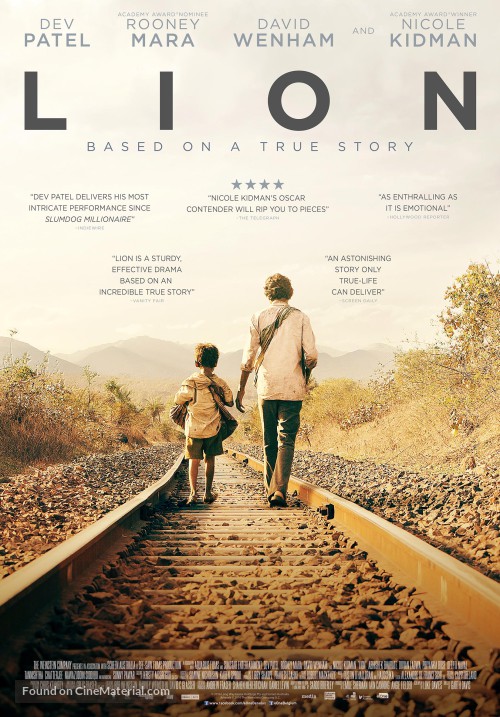
A five-year-old Indian boy gets lost on the streets of Calcutta, thousands of kilometers from home. He survives countless challenges before being adopted by a couple in Australia. After 25 years growing up in a context with almost nothing to do with his early childhood, his earliest memories begin to consume him – and he sets out to find his lost family.
Join us to witness this incredibly moving story of a journey away and back home again, a journey through which the very notion of nature, nurture, family, nostalgia and personal memory take on new meanings. This film is a must see.
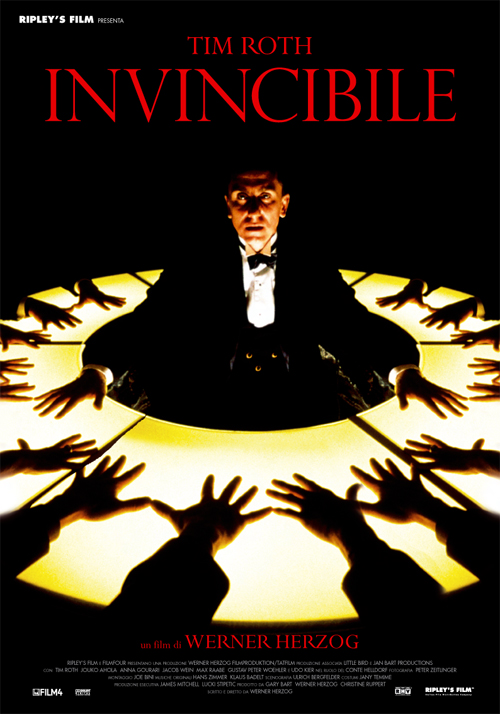
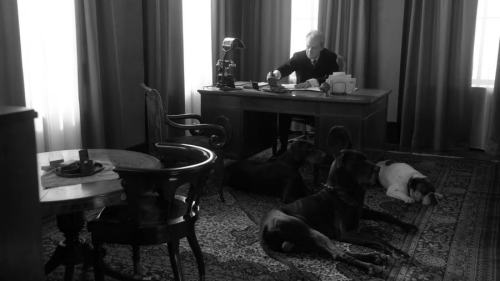
Werner Herzog’s “Invincible” tells the true story of a Jewish strongman in Nazi Germany. Keeping with last week’s cast, the sinister portrayal of Erik Jan Hanussen is played wonderfully by Tim Roth (The Legend of 1900). Written and Directed by Herzog, it has the power of a great silent film, unafraid of grand gestures and moral absolutes. Tim Roth poses as a man with real psychic powers, ruthless in using trickery and showmanship to jockey for position in the emerging Nazi majority. The strongman, played by Finnish athlete Jouko Ahola, is an actual twice winner of the title World’s Strongest Man, and provides an uncanny appeal in contrast to Roth. Set in 1932 in the last days of Weimar Berlin, this extraordinary tale provides a captivating story of strength and deception.
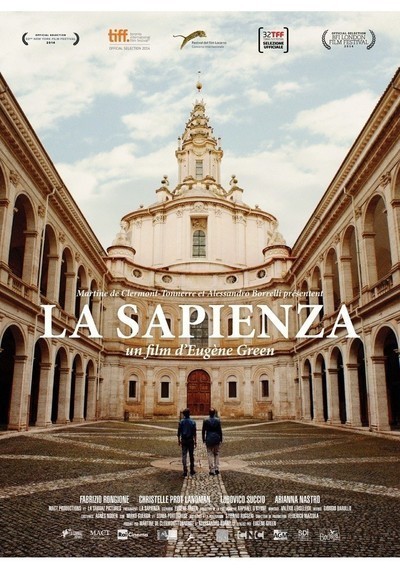
An aging architect (Fabrizio Rongione) tries to rediscover his passion by going on a research expedition to the birthplace of 17th-century master Francesco Borromini..Roger Ebert
“La Sapienza” strikes this reviewer as easily the most astonishing and important movie to emerge from France in quite some time. While its style deserves to be called stunningly original and rapturously beautiful, the film is boldest in its artistic and philosophical implications, which pointedly go against many dominant trends of the last half-century.
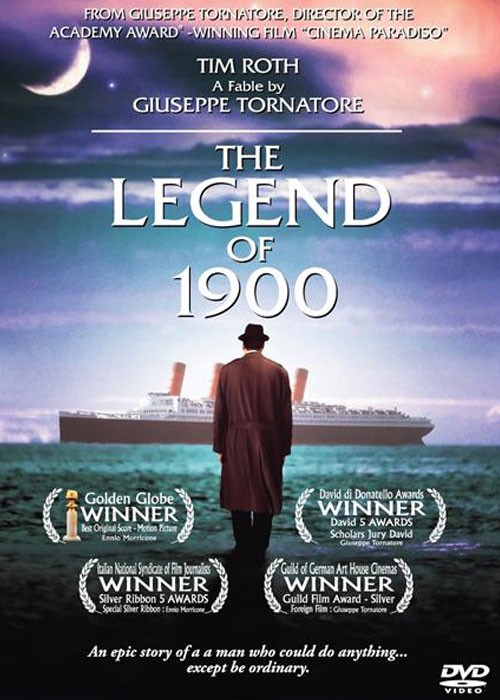
The Legend og 1900 was filmed at Cinecitta Studios in 1998. This is a story about a boy born on an ocean liner. Son of poor immigrants, he spent his life traveling back and forth across the Atlantic. He learned to play the piano and joined the ships orchestra. His reputation as a pianist became so renowned that Jelly Roll Morton joined him on-board for a piano challenge.
Music by Enio Morricone
Movie Review: The Legend of 1900
By Brad Kay
I happen to be a musician. I don’t think I’m a genius, but I am very tough on movies that purport to be about musical geniuses. These films all fall short of greatness, or even goodness, for the simple reason that a phenomenon like True Genius can only be observed. Genius doesn’t travel well beyond its native environment, or reproduce well in other hands. By the time they make it to pictures, works that started as fire and mystery end up as pickles in your fridge. With musical genius, pictures are at best incidental. So the movies about Mozart, Frederic Chopin, George Gershwin, Beethoven, Charlie Parker, among others, are to me little more than pretty picture postcards with better-than-average soundtracks. These gentlemen still are best appreciated through their actual musical scores or records.
However, The Legend of 1900 is a movie about a FICTIONAL musical genius, a pianist, who, in the year 1900, is discovered as a foundling infant on board the ocean liner S.S. Virginian, and spends his entire life aboard her, never touching foot on dry land. Therefore, SOME bets are off. Since there’s no one to compare him to, there can be no nitpicking about scores or authenticity. One has to evaluate “Danny Boodman T. D. Lemon 1900” on his own merits. I’m okay with that.
Also, since he IS a fictional character, we can allow ourselves to be drawn more readily into the conceit of the movie without kowtowing before the unyielding eye of History. What a relief! However, since music plays such a large role in the story, I also have to evaluate IT on its own merits, and I’m NOT ALWAYS okay with that.
Right from the edge, the piano playing, around which this whole picture revolves, makes a fair simulacrum of originality, at least enough to hang the story on, to keep our disbelief suspended. Sometimes the playing is mere glittery virtuosity of the kind we’ve heard from Liberace or Ferrante & Teischer – for instance, the Richard Rodgers-y waltz 1900 plays while he and the seasick Max are rolling around at the piano in the ship’s ballroom; or the tarantella he plays for the folks in steerage. His breaking off into bumptious arabesques while playing with the ship’s jazz band is equally superficial and also annoyingly unprofessional.
At other times, the music rises above that and we hear some truly impressive and moving stuff, such as the Mozart-like piece we see him playing as a child; the lovely blues he plays while looking out to sea (with prescient harmonies, natch, that wouldn’t be used until the 1940s). And of course, the beautiful theme (obviously the Big Tune of the picture) he records while gazing through a porthole at the incandescent Melanie Thierry. 1900’s piano playing therefore is a mixture of schlock and real beauty. I have to give Sergio Morricone, the composer, points for at least giving us enough to work with, something to chew on, kind of an audio-animatronic illusion of genius.
Speaking of prescience, Max, his trumpet-playing friend and confidante (and narrator of the picture), also is quite the phenom. Auditioning for the ship’s booker, circa 1920, he uncorks some VERY impressive Louis Armstrong-like gestures, which Louis himself wouldn’t arrive at until 1938 or so. Ah, there’s no sight like hindsight!
I loved the use of, and the rendition of, Scott Joplin’s “Peacherine Rag,” heard early in the movie when the child 1900 first invades the ship’s ballroom. Played by the ship’s orchestra, it is hard-hitting, brisk-tempo’d real-ass ragtime, circa 1906, and the dancers are MOVING. In many ways, it was the most authentic music in the whole picture. It stirred me from my torpor.
There were problems with the climactic “Piano Battle” with Jelly Roll Morton. The Morton role was miscast, for starters. The real Jelly was a light-skinned Creole, lean and wiry. Actor Clarence Williams III is a chunky, decidedly dark man, who in his white suit and shades looks more like “Superfly” than like the legendary Morton. His acting was credibly Morton-like, but now begs the question of how, in 1927, this very dark man got into this lily white ship’s lounge. The ‘haughty Spanish Grandee’ Jelly, who never cringed before whites, might have managed it – but not Superfly. The bit with the lit cigarette was, I think, contrived. Did Jelly really have to cut his playing off in the middle when the cig burned down? Never heard of that. The performance of Morton’s pieces, “Big Fat Ham,” “The Crave” and “Finger Breaker,” what we hear of them, is respectable and note-perfect, but to my ears totally dry. Jelly was a genuine real-life genius, and the gulf between his actual renderings and what we hear in this movie is very wide indeed (please re-read paragraph 1).
1900’s handling of the situation was the most original thing about it. His bewilderment and slowness-on-the-uptake at the concept of a Piano Battle is charming and funny. I won’t ruin it for you. But when he gets riled, he sprouts extra arms and hands and REALLY lets Jelly have it! The music department must have worked overtime to make a genuine go at a killer-diller shove-it-up-yer-ass piece, but to me it comes off as a spate of sweaty pianistic bludgeoning, lacking any subtlety whatsoever. Jelly Roll’s “Finger Breaker,” the piece 1900 supposedly bested, has a lot more nuance and originality.
The scene of 1900 cutting a record is SO wrong. Acoustical recording was ancient history by the time of this alleged session – they were using microphones and amplifiers by then. And you NEVER played a wax master – that would ruin it! And the equipment was wrongly positioned to capture the sound of the piano. And the record company guy talks like a hustling, payola-slinging hit-maker from the 1950s. And how that wax record survived so many playings in the pawn shop is beyond me.
Speaking of which, that pawn shop – where Max and “Pops,” the proprietor, reminisce – is jaw-droppingly amazing! All those beautiful instruments! All those rare 78-rpm records strewn everywhere! Oh my fuckin’ Christ!! The dust! The aroma! You couldn’t PRY me out of a place like that!
Music aside, the biggest plot hole in the story is how did 1900 avoid discovery? His concealment was plausible while he was hiding out in the bowels of the ship as a child. But after the funeral of his protector, Danny, attended by everybody and read over by the Captain, surely someone would have noticed this kid, got him safely off the boat into the hands of the Gerry Society or somebody, and that would have been the end of the picture. But little 1900 goes undetected, and lives exclusively on the Virginian for the rest of his life.
The big question is why does 1900 never debark? His friend Max is driven to distraction by this conundrum. He reveals to Max a philosophy of sorts for staying on board: “Why why why why why. I think ‘land people’ keep wondering ‘why?’. Winter comes, they think of summer. Summer comes, they live in dread of winter. It’s why they never tire of travelling, of chasing someplace where it’s always summer. Sounds like a bad bet to me.” Later, he waxes philosophical on Max about getting OFF the ship: “The land – it’s like a big scream telling you that life is immense. Once you’ve finally heard it, then you know what you have to do to go on living.” Well, as Ben Franklin once said, “It’s great to be a reasonable person. You can find a reason for doing ANYTHING.” To me, the real philosophy is that as long as 1900 stays on board the Virginian, we keep on watching the picture.
Of course, in real life, the TRUE talent in The Legend of 1900 is buried under the keel of the ship. I had to look deep dark down in the tiny type of the credit crawl at the end of the movie, and also scroll way the hell down amongst the cast and crew listing in the Internet Movie Database. But by gum, I found her! THE ACTUAL PIANIST WHO DID THE ACTUAL PLAYING FOR THIS PICTURE!! Her name is Gilda Butta. I’ll say it again: GILDA BUTTA! Don’t bother to thank me on your way out.
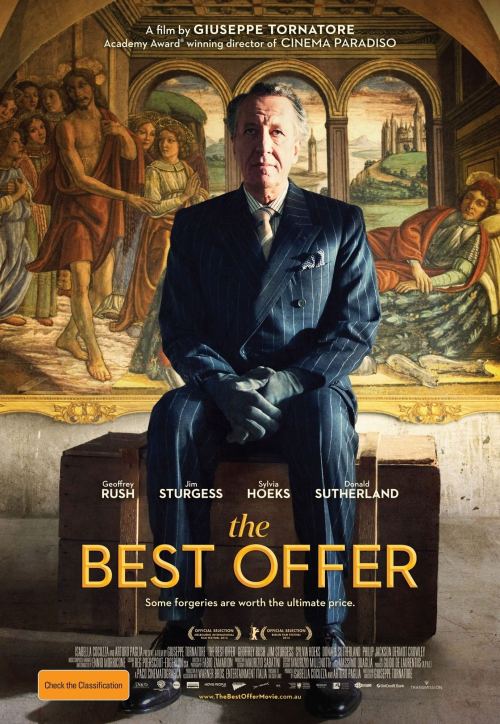
One of our favorite films in Cinematiki that we showed very early on was Cinema Paradiso by Giuseppe Tornatore.
Monday, January 16th we are screening one of his more recent films, The Best Offer with Geoffrey Rush, Silvia Hoeks, Jim Sturgees, and Donald Sutherland.
The film has won numerous awards in Europe, and it should prove to be an interesting evening.
Potluck dinner at 5:45pm, Screening at 6:45pm. Discussion to follow film.
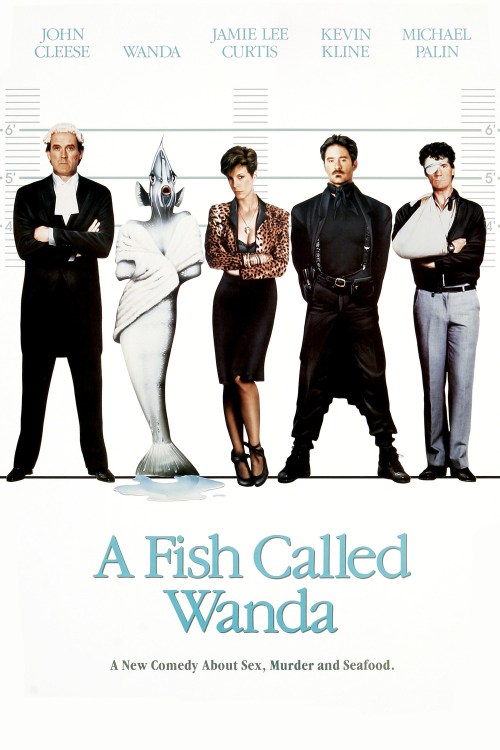
An ambitious and sexy con artist uses every tool at her disposal to obtain a fortune in jewels. To help in her plan, she woo’s her lover’s deadly henchman and then his attorney, eventually falling in love with one of them.
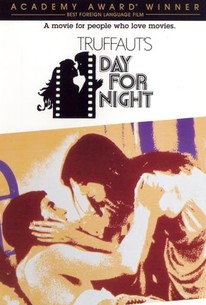
Come to howl at the full moon and help us celebrate the Cinematiki’s 8th Anniversary and J.J.’s birth day…
We are presenting “Day for Night” by Francois Truffaut . A film about films and the people that populates the world of cinema … It is one of two Truffaut films featured on Time magazine’s list of the 100 Best Films of the Century, along with The 400 Blows.. It has also been called “the most beloved film ever made about filmmaking.”
it was the first film that we showed at the Cinematiki eight years ago… since then we’ve seen and discussed over 350 films…
Academy Award Nominated Director, Jan Troell is one of Sweden’s most acclaimed filmmakers. “The Last Sentence” was the Stockholm International Film Festival’s official selection. It is based on the life of crusading Journalist, Torgny Segerstedt, editor-in-chief of one of Sweden’s leading newspapers. This film high-lights his one-man battle against Nazism.
“A work of a master director, ultimate storytelling”
“Extremely compelling film about a conflicted man”
***Cinematiki has recently subscribed to FANDOR films, allowing us to stream art films from all over the world. “The Last Sentence” is our first FANDOR film. Yahoo!
Motion picture pioneer Auguste Lumière was born in Besançon, France, and his father was a former painter who had taken up photography. Auguste and his younger brother Louis studied science in Lyon, and opened a successful business producing photographic plates. Their father returned home from a trip to Paris in 1894, full of descriptions of Thomas Edison’s new Kinetoscope: a peephole machine that pulled strips of film in front of a light source, creating the illusion of movement. The Lumière brothers began work on a device that would project the images, and in February 1895, they patented their cinématographe, which was an all-in-one camera, developer, and projector. A month later, they shot their first footage of workers leaving their factory in Lyon. They held their first public screening that December, showing 10 short films – each of them about a minute long – depicting scenes from everyday life. One film in particular provoked a strong reaction: the Lumières had filmed a train pulling into a station head-on, and the audience members screamed and scrambled out of their seats, believing the train was about to plow through the screen into the theater.
Auguste Lumière wasn’t much interested in pursuing further developments in motion picture technology, being more interested in medical research. He reportedly said, “My invention can be exploited . as a scientific curiosity, but apart from that it has no commercial value whatsoever.”


 Cinematiki Maui